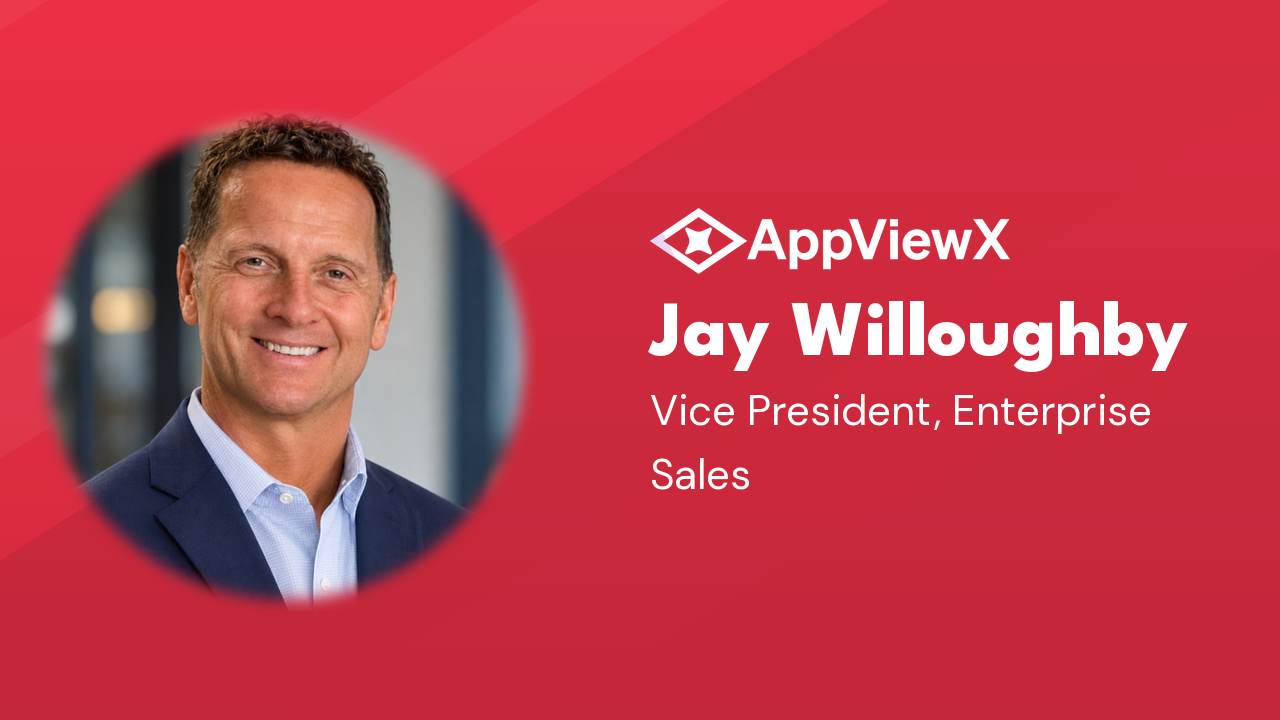
Jay Willoughby joined AppViewX as Vice President, Enterprise Sales, with a first-year focus on building its enterprise sales motion in the West and its Fortune 500 relationships. He arrives as certificate outages, fast-growing fleets of AI agents and post-quantum cryptography deadlines turn machine identity into a board-level risk. Below, he explains who inside a large company asks about machine identity first, why the CFO now joins those deals earlier, how he prices the cost of doing nothing, and how he is building the AppViewX enterprise sales team for 2027.
What drew you to AppViewX, and what does the enterprise sales role cover in your first year?
AppViewX is solving a problem that most enterprises didn’t fully understand they had until recently, and now it’s urgent. Securing machine identities and certificate lifecycle management used to live in the background. Today, with the rapid adoption of AI agents and the looming pressure of post-quantum cryptography, it’s a board-level risk conversation. I wanted to be in a market that’s moving fast for the right reasons. In the first year, the focus is building out our enterprise sales motion in the West, deepening relationships with the Fortune 500, expanding our footprint with existing customers, and making sure we have the right coverage model to support the deals we’re going after in 2027.
Advertisement
When large enterprises evaluate machine identity and CLM, what questions come up first, and who asks them?
The first question is usually “what do we even have?”, and it comes from the security team, often in response to an audit finding or an outage caused by an expired certificate. From there, the CISO wants to know about risk exposure and compliance posture, and the infrastructure or platform team wants to know how this fits into their existing PKI and automation workflows. What’s changed in the last two years is that the CFO is showing up earlier, because they’ve started connecting certificate-related incidents to real downtime costs. The deal has always involved multiple stakeholders, now the financial case needs to be airtight from the start.
AI agents are creating a new wave of non-human identities. How does AppViewX help enterprises stay ahead of that, and how do you approach conversations?
This is one of the fastest-moving parts of the conversation. Every AI agent an enterprise deploys is a new non-human identity that needs credentials and governance, and most organizations are spinning them up faster than their security teams can track. That is the gap AppViewX closes. We discover every agent, including the shadow ones nobody registered, map each one to its owners, credentials, and the tools it can reach, and control what it does in real time, down to revoking access or triggering a kill switch when an agent goes rogue. I frame it as getting ahead of the risk before it becomes an audit finding or security incident.
What do enterprise buyers get wrong about the cost of doing nothing, and how do you frame that in a deal?
Most buyers underestimate the blast radius of a certificate outage until they’ve had one. They’ll budget around the tooling cost but not the operational risk, the engineering hours, the incident response, and the audit findings that follow. I try to flip the conversation early. Instead of saying “here’s what AppViewX costs,” it becomes “here’s what an unmanaged certificate environment is already costing you, whether you can see it or not.” The cost of doing nothing isn’t zero. It’s just deferred, and usually larger.
The same risk applies as it relates to being post-quantum ready. New cryptographic standards are coming, and the organizations that wait will be the ones scrambling to inventory and rotate weak cryptography under a deadline they don’t control. The ones that start now, with full visibility and automation already in place, turn what could be a compliance fire drill into a routine migration.
How are you structuring the enterprise sales team for 2027: territories, specialists, or partners?
All three, but in a deliberate sequence. Territory coverage comes first, you need the right people in front of the right accounts. We’re layering in technical specialists who can support complex proof-of-concept cycles, because the AppViewX deal often involves deep integration work and buyers need to see it operate in their environment. And the channel and partner motion is a multiplier, the right GSI or VAR relationships extend our reach into accounts we couldn’t cover efficiently on our own. I want the team to be structured so that no deal falls through because of a coverage gap or a lack of technical depth when it matters.
What’s one practice from earlier in your career you’re bringing to AppViewX?
Discipline around discovery. Early in my career I learned, the hard way, that the fastest deals I lost were ones where I thought I understood the problem better than I actually did. The best enterprise reps I’ve worked with spend more time in discovery than any other part of the cycle. At AppViewX, where the technical complexity is high and the stakeholder map spans security, infrastructure, finance, and increasingly the AI Centers of Excellence being stood up to govern AI agents, that discipline isn’t optional. You have to understand the real driver before you can build a case that holds up through a long enterprise cycle.